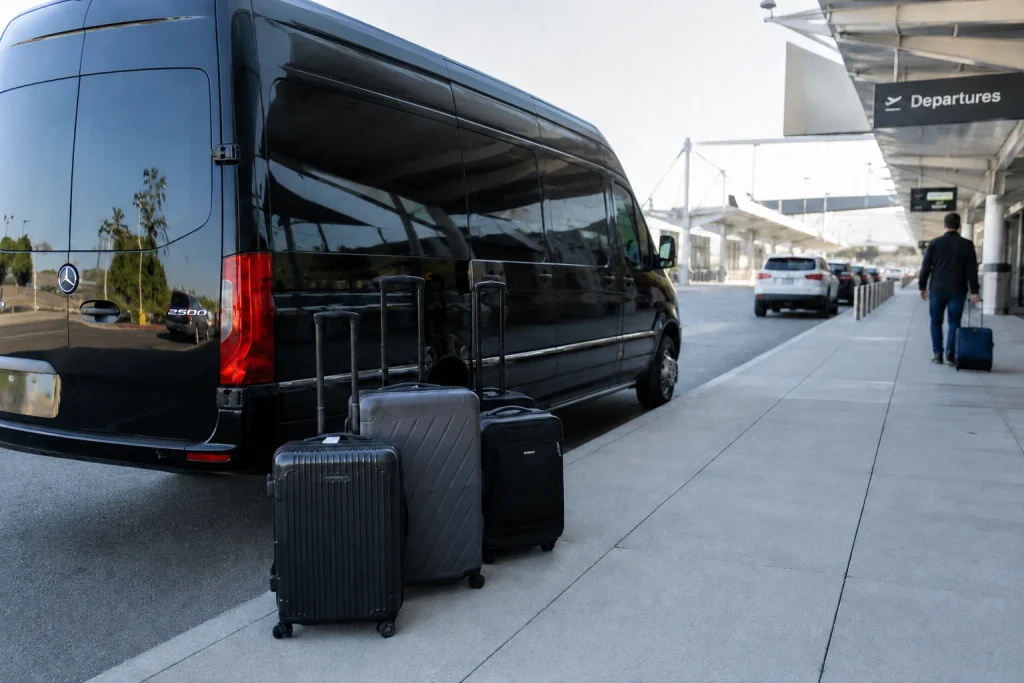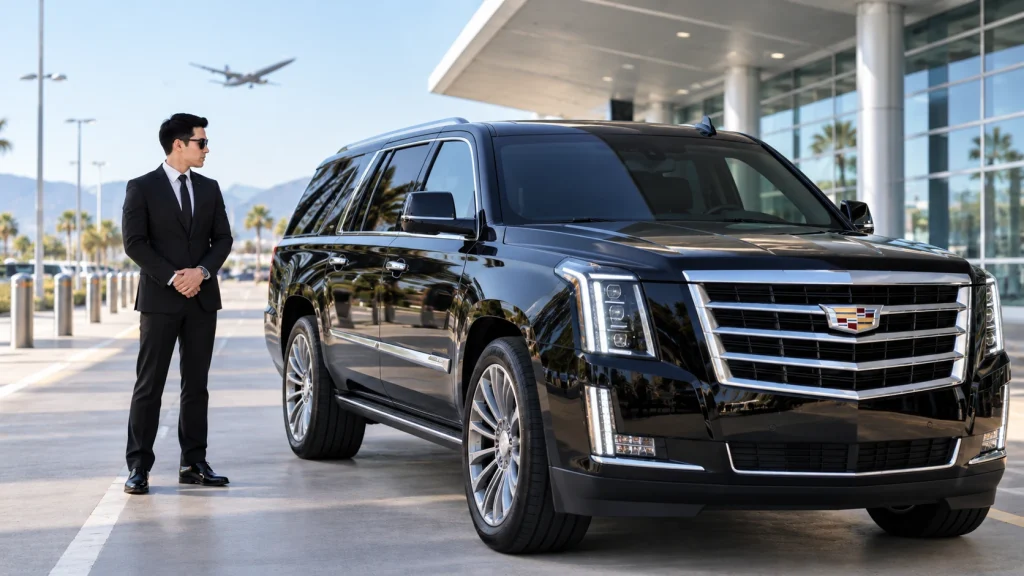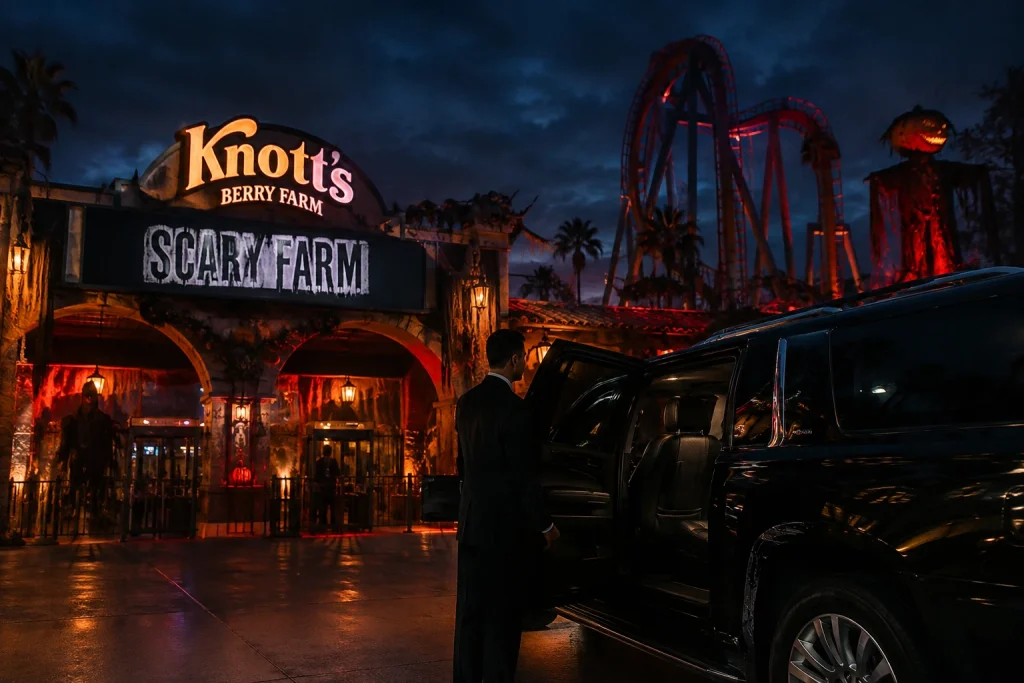


A multi-stop limo service works by reserving one vehicle and one chauffeur for a continuous block of time, so your group keeps the same car from the first pickup through every stop to the final drop-off. You are not buying separate rides. You are buying uninterrupted access to a vehicle that waits, repositions, and moves on your schedule. Put simply, a multi-stop limo service is time-based transportation rather than distance-based transportation. Inland Empire riders book this way for wine tours, wedding days, and corporate roadshows. It also covers airport runs with side stops and birthday routes across three or four cities.
That single detail changes the pricing, the planning, and the risk profile of the trip. A rideshare route with four separate pickups exposes you to four separate wait times, four surge windows, and four drivers who know nothing about your itinerary. A multi-stop limo service removes that fragmentation. The trade-off is that you pay for the gaps between stops, which is why route design matters more here than in any other kind of ground transportation.
Table of Contents
- What a Multi-Stop Limo Service Actually Covers
- How the Routing and Timing Work Behind the Scenes
- The Cost Math: Hourly Blocks vs. Point-to-Point
- Southern California Traffic Patterns That Shape Your Stops
- Matching Vehicle Size to Stop Count and Group Size
- Risk Analysis: Where Multi-Stop Trips Go Wrong
- 7 Rules That Keep a Multi-Stop Route on Schedule
- Local Relevance: Redlands, Chino, and the I-10 Corridor
- Frequently Asked Questions
- Final Takeaway
What a Multi-Stop Limo Service Actually Covers
A multi-stop limo service covers three things at once: the vehicle, the chauffeur’s time, and the waiting periods between your stops. Standard airport transfers only cover the drive itself. That difference explains most of the confusion riders have when they compare quotes.
The booking is built as an hourly charter with a defined start location, a sequence of stops, and an end location. Your chauffeur stays on site during each stop. Nothing is released back to the dispatch pool between legs. When people ask what makes a multi-stop limo service different from calling a car four times, that dedicated hold is the entire answer.
Typical inclusions on a well-written multi-stop limo service charter are:
- A named chauffeur assigned for the full duration, not a rotating driver pool
- Wait time at every stop, billed inside the hourly block rather than as extra fees
- Luggage handling and reloading at each transition
- Route planning done before the day, with backup paths for known bottlenecks
- Direct phone contact with dispatch while the trip is live
What the charter does not usually include is unlimited flexibility at no cost. Adding a fifth stop at 11 p.m. is possible, but it extends the hourly block. A good operator tells you that before the trip, not after. The chauffeured limousine services offered across the Inland Empire use exactly this structure. Reading the hourly terms carefully is worth the five minutes it takes.
How the Routing and Timing Work Behind the Scenes
Every multi-stop limo service booking starts with a planning call. Before your date, dispatch converts your stop list into a timed route. Each stop gets three numbers: an arrival time, a dwell time, and a departure time. The dwell time is the piece most clients underestimate.
Industry scheduling practice treats dwell time as a function of group size. Many operators use a rough working model. Allow two to three minutes per passenger at a residential stop. Allow five to seven minutes at a venue with a controlled entrance. A twelve-person group at a hotel entrance is therefore closer to a fifteen-minute stop than the five minutes most people picture. Across a six-stop night, that estimating error alone can cost an hour.
Dispatch then pads the drive legs. Padding is not padding for profit. It is buffer built against variance. Drive times in Southern California swing widely enough that an average is a poor planning number. A trip from Redlands to downtown Los Angeles might average 85 minutes. The same trip can hit 140 minutes on a Friday at 4 p.m.
The practical result is that a well-built multi-stop limo service itinerary usually shows more total time than the client’s own estimate. That gap is deliberate. When the route finishes early, you release the vehicle early. When the route runs long, you already have room. Operators who quote tight windows to win a price comparison tend to deliver late arrivals, which is the single most common complaint in chauffeured ground transportation reviews.
The Cost Math: Hourly Blocks vs. Point-to-Point
Pricing a multi-stop limo service is simpler than it looks once you separate the two models. Here is where the numbers get useful. Point-to-point pricing charges per leg. Hourly charter pricing charges for continuous possession of the vehicle. The break-even between them depends almost entirely on how long you stop.
Consider a six-passenger group planning four stops across a single evening in the Inland Empire. Using typical regional pricing ranges, the comparison looks like this:
| Trip Structure | Billed Units | Typical Range | Wait Risk |
|---|---|---|---|
| Four separate point-to-point rides | 4 legs plus surge exposure | $260 to $420 | High, 10 to 25 min per leg |
| Rideshare XL, four separate requests | 4 requests plus surge | $180 to $400 | Very high on weekend nights |
| Hourly multi-stop limo service, 5-hour block | 5 hours plus gratuity | $475 to $750 | None, vehicle is held |
| Hourly charter, 8-hour wedding block | 8 hours plus gratuity | $760 to $1,200 | None, vehicle is held |
Read those rows carefully. On raw dollars, separate rides often look cheaper. That comparison only holds when your stops are short and your timing is flexible. Once a stop runs past roughly twenty minutes, the math shifts. The same happens once your group exceeds four people. With a multi-stop limo service you stop paying the hidden cost of waiting for a new vehicle each time.
There is a second cost most people never price: the cost of a missed window. A late arrival at a wedding venue, a delayed departure to an airport, or a group split across two cars at a corporate dinner carries real consequences. A multi-stop limo service converts that variable risk into a fixed line item on a quote. For planners, predictability is often worth more than the spread between two prices.
Gratuity conventions add another layer. Most Inland Empire operators either include 18 to 20 percent in the quote or list it separately. Ask which, because a quote that excludes it is not really lower. Browsing the available limousine and SUV fleet before you request pricing helps, since vehicle class drives the hourly rate more than any other single factor.
Southern California Traffic Patterns That Shape Your Stops
Route planning in this region is a traffic problem first and a logistics problem second. Southern California congestion follows patterns that are stable enough to plan around, and any competent multi-stop limo service dispatcher builds around them.
Regional congestion data from sources like the Federal Highway Administration consistently shows peak-period travel times running 40 to 70 percent above free-flow conditions in dense metro corridors. In practice, that maps to a few reliable rules for Inland Empire routes:
- I-10 westbound stiffens from roughly 6:30 a.m. to 9:30 a.m. A 7 a.m. airport departure from Redlands needs a departure time, not a wish.
- SR-60 and I-15 interchanges carry heavy freight volume midday, which makes early-afternoon legs less predictable than people assume.
- Friday afternoons are the worst planning environment of the week. Between 3 p.m. and 7 p.m., variance matters more than averages.
- Event nights near Ontario, San Bernardino, and downtown LA venues add 20 to 45 minutes of egress time after the final act ends.
Those patterns are why an experienced multi-stop limo service will sometimes reorder your stop list. Reversing two stops can cut a full hour off a route by avoiding a single bad interchange at the wrong time. Clients occasionally push back on this, and then arrive relaxed anyway.
Weather adds a smaller but real factor to any multi-stop limo service route. Rain in this region reduces effective freeway capacity noticeably, largely because local drivers see it so rarely. Two or three rain days a year are enough to justify a twenty-minute buffer on a wedding timeline.
Matching Vehicle Size to Stop Count and Group Size
Vehicle selection decides half the timing on a multi-stop limo service. Stop count and group size interact. A large vehicle reduces the number of trips but increases the time needed at each curb. A smaller sedan loads fast but forces a second vehicle for bigger groups.
| Group Size | Best Fit | Loading Time per Stop | Best Use Case |
|---|---|---|---|
| 1 to 3 | Luxury sedan | 2 to 4 minutes | Executive roadshows, airport plus office stop |
| 4 to 6 | Premium SUV | 4 to 6 minutes | Dinner and event routes, small wine tours |
| 7 to 12 | Stretch limousine | 6 to 10 minutes | Weddings, birthdays, prom routes |
| 13 to 30 | Party bus or sprinter | 8 to 15 minutes | Multi-city group nights, corporate outings |
A useful planning check is the stop-to-hour ratio. As a rule of thumb, more than three stops per hour is unrealistic for any group above six people. Picture a twelve-person party asking for eight stops in four hours. That itinerary is already mathematically unsound before a single tire turns.
Vehicle choice also affects where you can physically stop. Stretch limousines and party buses cannot enter every parking structure or narrow residential cul-de-sac. Dispatch checks curb access ahead of time for exactly this reason, and a good multi-stop limo service will flag a stop that a 30-foot vehicle simply cannot reach.
Risk Analysis: Where Multi-Stop Trips Go Wrong
Most failed itineraries fail for predictable reasons. Looking at the common complaint patterns in chauffeured transportation, four causes account for the large majority of problems on a multi-stop limo service booking.
1. Underestimated dwell time
Groups say ten minutes and take thirty. This is the number one cause of overtime charges. Every extra ten minutes at a stop pushes the entire back half of the night.
2. Unconfirmed stop addresses
A venue name is not an address. Restaurants move, entrances change, and large properties have separate rideshare and limousine loading zones. Confirming the exact loading point for each stop removes a surprising amount of friction.
3. Booking the minimum hours
Clients often book four hours for a five-hour plan and hope to compress the difference. Overtime is usually billed in 30-minute increments at the standard rate, so the savings evaporate quickly. Booking honestly costs less than booking optimistically.
4. Choosing an operator with no backup vehicle
Mechanical issues happen. The relevant question is what happens next. A properly licensed multi-stop limo service operator maintains a fleet and a relationship network that can send a replacement vehicle. A single-car operator cannot. Checking the operator’s California Public Utilities Commission TCP license before booking takes two minutes and filters out most unlicensed operators.
Insurance verification belongs in the same category. Commercial livery coverage differs meaningfully from personal auto coverage. Any operator should provide a certificate on request without hesitation. If you want context on how an established Inland Empire operator is structured, the story behind The Perfect Limo brand covers licensing, fleet standards, and chauffeur training.
7 Rules That Keep a Multi-Stop Route on Schedule
These multi-stop limo service rules come from patterns operators see repeatedly. They apply to weddings, wine tours, and corporate roadshows alike.
- Write the itinerary backward from your hard deadline. If dinner reservations are at 7:30, build the route from that fixed point outward.
- Add fifteen percent to your own time estimate. Clients underestimate dwell time almost universally.
- Give exact loading addresses, not venue names. Include gate numbers and entrance names where they exist.
- Name one point of contact. A chauffeur receiving three conflicting directions from three passengers loses time on every stop.
- Confirm the vehicle can physically reach each stop. Height limits, turning radius, and loading zones all matter.
- Ask how overtime is billed. Increment length and rate should be in writing before the trip.
- Book the block you actually need. A five-hour multi-stop limo service booked as four hours is not a four-hour trip. It is a five-hour trip with a surprise at the end.
Following those seven rules removes most of the friction people associate with group transportation. None of them require expertise. They just require writing the plan down before the day arrives.
Local Relevance: Redlands, Chino, and the I-10 Corridor
Inland Empire geography rewards this style of booking. Redlands, Loma Linda, San Bernardino, Rancho Cucamonga, Chino, and Ontario sit close together. Four or five stops in one evening are realistic here. The distances are still long enough that separate rides waste real time. That middle zone is exactly where a multi-stop limo service earns its cost.
Local multi-stop limo service routes fall into a few recognizable shapes. Wedding days typically run from a getting-ready location to a church, then to a venue, then to a hotel block. Wine tours cluster around Temecula with a long return leg. Airport itineraries pair Ontario International or LAX with an office stop or a hotel pickup. Concert nights move from a home pickup to dinner, then to a venue, then home again after an hour of parking egress.
Regional event volume matters too. Ontario, San Bernardino, and the greater LA venues generate enough weekend demand that peak Saturday inventory gets booked weeks ahead during spring wedding and prom season. Book a multi-stop limo service in April or May with under three weeks of lead time. You will usually choose from what is left rather than what you wanted.
Local knowledge also shows up in small decisions. Which downtown Redlands blocks allow a stretch limousine to stage. Which Ontario terminal curb clears fastest at 6 a.m. Which venue exits jam after a show. Those details separate a smooth night from a stressful one. That operational familiarity is a real part of what you pay for with Redlands Limo Service, and it is difficult to replicate with an app.
If you are still comparing formats, reading through more limousine travel guides and booking tips is a reasonable next step before you commit to an itinerary.
Frequently Asked Questions
How many stops can I add to one booking?
There is no hard cap on a multi-stop limo service, but there is a practical one. Most operators recommend no more than three stops per hour for groups under six, and fewer for larger parties. Beyond that, the itinerary stops being a schedule and becomes a hope. Dispatch will usually tell you honestly whether your stop list fits the hours you booked.
Do I pay for the time the limo is just waiting?
Yes, and that is the correct way to think about it. In a multi-stop limo service, you are renting continuous access to the vehicle and chauffeur. Waiting time is included inside the hourly block rather than charged as a separate fee, which is generally cheaper than booking a fresh vehicle for every leg.
Can I change stops on the day of the trip?
Usually yes, within reason. Adding a nearby stop is simple. Adding a stop thirty miles off the planned route may extend your hourly block or push a hard deadline. Tell your chauffeur as early as possible so dispatch can recalculate the timing rather than discovering the change at the curb.
Is a multi-stop limo service cheaper than several rideshare trips?
Not always on the sticker price, but often on total cost. Once you add surge pricing, repeated wait times, and the risk of a group being split across vehicles, the gap narrows sharply. For groups of six or more with stops longer than twenty minutes, the hourly charter typically wins on both cost and reliability.
What is the minimum booking length?
Three to four hours is standard across most Inland Empire operators, with longer minimums on Saturdays and during peak wedding season. Airport transfers are the usual exception, since those are priced point-to-point.
How far in advance should I book?
Two to four weeks for ordinary weekends. Six to eight weeks for spring weddings, prom season, and holiday dates. If your date is fixed and your vehicle preference is specific, earlier is always better. You can check current availability directly through the Redlands Limo Service booking and quote request page.
What happens if my group runs late?
The chauffeur waits and the clock keeps running. Overtime is normally billed in 30-minute increments at the standard hourly rate. Nothing is canceled, and no one is stranded, which is precisely the protection a multi-stop limo service is designed to provide.
Final Takeaway
A multi-stop limo service works best when it is planned as a timeline rather than a list of places. Reserve the hours you actually need, give exact loading addresses, name one decision maker, and let dispatch order the stops around regional traffic instead of around convenience. Do those four things and the trip runs quietly in the background, which is the entire point.
The cost comparison ultimately comes down to what you value. Separate rides can win on raw price for small, flexible groups. A multi-stop limo service wins on predictability, group cohesion, and the elimination of wait risk, and in the Inland Empire that predictability is usually what people are actually buying. When several people, several stops, and a fixed deadline are involved, the hourly charter is the structure that holds up.
Connect with Redlands Limo Service
Email: redlands@theperfectlimo.com
Find us on Google Maps
Facebook
Yelp
Pinterest
YouTube
TikTok