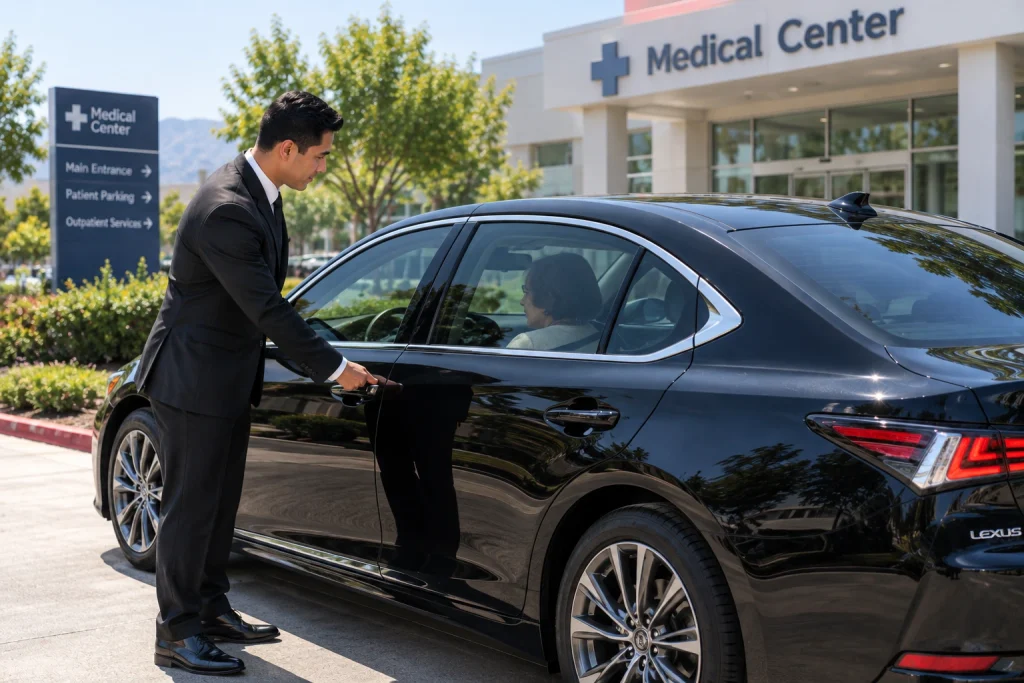


Medical appointment transportation in Redlands works best when you book two to three days ahead, confirm the pickup and return plan in writing, and match the vehicle to how the patient actually moves. That is the short answer. The rest of this guide shows you how to do it step by step, what it costs in time and money, and where private car service ends and licensed medical transport begins.
This guide covers planned, non-emergency trips only. If someone has chest pain, trouble breathing, or any sudden danger, call 911 first. For a clinic visit, imaging, a specialist consult, or a recurring treatment, the steps for medical appointment transportation stay the same every time. Read the page once, then use the ride-day checklist before each trip.
Table of Contents
- What Medical Appointment Transportation Actually Means
- Medi-Cal Rides, Medical Vans, and Private Cars Compared
- When a Private Car Service Fits and When It Does Not
- Common Medical Destinations Around Redlands
- Step-by-Step: How to Book Your Ride
- How Much Time to Build In
- Cost Analysis: Where the Money Actually Goes
- Risks, Mistakes, and Smart Alternatives
- Ride-Day Checklist
- Booking With Redlands Limo Service
- Conclusion
- Frequently Asked Questions
What Medical Appointment Transportation Actually Means
People use the phrase medical appointment transportation for very different things. A senior who no longer drives at night needs one kind of help. A patient leaving a procedure with sedation needs another. A family flying a relative in for treatment needs a third. The common thread is simple: a reliable ride to and from a health visit, with no stress about parking, traffic, or getting home safely.
In practice, the service falls into three groups. The first is public or benefit-based rides, such as the trips some Medi-Cal plans arrange. The second is licensed medical transport, which uses ambulances, litter vans, or wheelchair vans. The third is private chauffeured service, where a professional driver takes you door to door in a sedan or SUV. Each has a place. Problems start when families pick the wrong group for the patient’s condition.
Redlands makes this choice more important than it first appears. The city sits between Loma Linda, San Bernardino, and Riverside, so many patients cross more than one city for a single treatment plan. A trip that looks short on the map can turn long once the 10 freeway slows down. Good medical appointment transportation plans for that before the day arrives.
Medi-Cal Rides, Medical Vans, and Private Cars Compared
California separates two benefit types, and the difference matters. According to the California Department of Health Care Services transportation page, non-medical transportation covers people who have no other way to reach an appointment, while non-emergency medical transportation covers people who cannot safely use a regular vehicle and need an ambulance, wheelchair van, or litter van. NEMT usually needs a written order from a provider.
Private car service is neither of those. It is a paid, chauffeured ride for people who can sit in a normal car seat, with or without a little help getting in and out. The table below shows how the three options compare.
| Option | Best for | How you arrange it | Main limit |
|---|---|---|---|
| Medi-Cal non-medical transportation | Members with no other ride who can travel in a regular vehicle | Through your health plan or its transport provider | Scheduling windows and plan rules |
| Non-emergency medical transport | Patients who need a wheelchair van, litter van, or ambulance | Provider order, then plan or provider booking | Needs medical certification and approval |
| Private chauffeured car service | Patients who can ride in a standard seat and want comfort, control, and flexible timing | Direct booking with the car service | Not a medical vehicle and no clinical care in the car |
| Rideshare | Short, simple trips for independent riders | App | Surge pricing, driver cancellations, no waiting |
If you are unsure which row fits, ask the patient’s doctor or care coordinator. They know the person’s mobility, medication effects, and recovery plan. A quick question there protects the patient far better than a guess does when you choose medical appointment transportation.
When a Private Car Service Fits and When It Does Not
Good fits for a chauffeured ride
Private medical appointment transportation tends to work well for adults who walk on their own or with a cane, for patients who feel tired or lightheaded after a visit but can sit upright, and for families who want one driver for the whole day. It also suits patients who have a long list of stops, such as a lab in the morning, a specialist at noon, and a pharmacy before home.
Comfort is the other big factor. A clean, quiet vehicle lowers stress before a hard conversation with a doctor and gives patients a calm space after one. For many families, that is the real reason they choose medical appointment transportation with a professional driver over a rushed ride from a relative who has to leave work.
Situations that need a different service
Choose licensed medical transport if the patient uses a wheelchair that cannot fold, needs to lie flat, depends on oxygen equipment or monitoring during the ride, or cannot safely transfer between seats. A chauffeur is a driver, not a caregiver. Do not ask a driver to provide lifting, medication, or clinical help.
Also plan a companion for anyone who may be confused, unsteady, or unable to give clear instructions after a procedure. The companion can handle paperwork at the front desk while the driver waits with the vehicle. This single choice prevents many of the stressful moments families report after surgery or sedation.
Common Medical Destinations Around Redlands
Loma Linda University Medical Center
Loma Linda is the most common destination for Redlands patients because it sits just west of the city and hosts a wide range of specialty care. The Loma Linda University Medical Center page lists parking structure and drop-off details, and those can change as the campus grows. Check it before you go and tell your driver which entrance you want.
Redlands hospitals and local clinics
Many visits happen inside Redlands itself, at hospital outpatient departments, primary care offices, physical therapy clinics, and imaging centers. Even short medical appointment transportation trips benefit from a planned pickup time. Short rides fail most often because of a tight schedule, not distance.
San Bernardino, Colton, Fontana, and Riverside
Patients are often referred to Arrowhead Regional Medical Center in Colton, Kaiser Permanente in Fontana, or Riverside Community Hospital. These drives cross county lines and busy freeway corridors. Morning and late afternoon traffic can add a lot of time, so a Redlands medical trip to these hubs needs a bigger buffer than the map suggests.
Step-by-Step: How to Book Your Ride
Follow these steps in order. They take about ten minutes, and they remove most of the problems that cause late arrivals.
Step 1: Collect the appointment facts
Write down the appointment date, check-in time, full address, building or suite, and the clinic phone number. Check-in time is often earlier than the appointment time, and that is the time your ride should target. Many patients give the car service the wrong hour because they quote the visit start, and medical appointment transportation only works when the times are right.
Step 2: Define the patient’s mobility
Be honest about how the patient walks, climbs stairs, and sits. Say whether a cane, walker, or foldable chair is coming along. This is the most important detail for safe medical appointment transportation, because it tells the booking team whether a sedan, SUV, or a different service is the right match.
Step 3: Decide on a one-way or round-trip plan
Ask whether the driver will wait, return later, or come back when you call. Waiting suits short visits. A scheduled return works better for long procedures. Never leave the return trip as a vague idea, because clinics run late and patients leave tired. A clear return plan makes medical appointment transportation far less stressful.
Step 4: Request a quote and confirm in writing
Tell the booking team the pickup address, destination, check-in time, and return plan. You can send those details through the Redlands Limo Service contact page. Ask for the quote, the pickup time, and any waiting policy in writing so everyone has the same plan.
Step 5: Share pickup details and a backup contact
Give the exact door or gate, a phone number that will be answered, and a second contact such as a family member. If the patient does not use a phone, put the family number first. Add any gate code or apartment instruction now, not on the morning of the trip.
Step 6: Reconfirm the day before
Send a short message the day before to confirm the time and vehicle. Check the weather, the route, and any road closures. A two-minute check beats a stressful phone call at the curb.
How Much Time to Build In
Most late arrivals come from three small delays stacking up: a slow pickup, heavy freeway traffic, and a long walk from parking to the clinic. The numbers below are planning guidelines for medical appointment transportation, based on common patterns and not promises. Adjust them for your own route and the patient’s pace.
| Appointment type | Suggested arrival buffer | Typical wait plan |
|---|---|---|
| Routine check-up | 15 to 20 minutes before check-in | Driver waits or returns on call |
| Imaging or lab work | 20 to 30 minutes before check-in | Return on call |
| Specialist consult | 20 to 30 minutes before check-in | Driver waits or scheduled return |
| Procedure with sedation | 30 minutes before check-in | Scheduled return with a companion |
| Recurring treatment | Match the clinic’s chair or session schedule | Standing weekly booking |
Here is a simple example. A patient has a one-hour specialist visit. Add 20 minutes for check-in, 15 minutes for checkout and pharmacy questions, and 20 minutes of traffic cushion. That is about two hours and 15 minutes door to door beyond the drive. If you plan only for the visit itself, the ride will feel rushed, and that stress is easy to avoid.
For patients who tire quickly, build in a rest stop before the ride home. A few quiet minutes in the lobby can make the trip back far more comfortable. Good medical appointment transportation always leaves room for the human side of a hospital day.
Cost Analysis: Where the Money Actually Goes
Rates for medical appointment transportation depend on distance, vehicle, time of day, and how long the driver waits, so ask for a written quote instead of relying on an average. What you can compare is the structure of the cost. Four drivers explain most of the final price:
- Distance: Redlands to Loma Linda is a short trip, while Redlands to Riverside or Fontana adds miles and traffic time.
- Waiting time: A driver who stays through a two-hour visit costs more than a drop-off and a later return.
- Round trip or one way: Two separate rides often cost more than one planned round trip.
- Vehicle size: A sedan costs less than an SUV, but a companion or mobility aid can make the larger vehicle the better value.
Now compare the hidden costs of the alternatives. A relative who drives loses a work shift and pays for parking. A rideshare can cancel at the curb, and surge pricing spikes near busy hospital hours. A missed or late appointment can lead to a rescheduling delay that pushes care back by weeks. When you add those up, medical appointment transportation with a booked driver often costs less in stress and lost time than it first seems.
If budget is tight, ask your health plan whether any rides are covered before paying out of pocket. Some members qualify for plan-arranged rides, and the plan can explain the rules in a short call. Use private service for the visits where comfort and flexibility matter most.
Risks, Mistakes, and Smart Alternatives
Mistakes that cause the most trouble
- Booking to the appointment time: Aim for the check-in time instead, and arrive early.
- Skipping the return plan: Waiting for a ride at a busy entrance tires patients fast.
- Underestimating mobility needs: A vehicle that is too low or too small causes pain and delay.
- Using a car service as a medical service: Drivers are not trained to provide clinical care.
- Waiting until the last minute: Same-day bookings leave little room to fix problems.
Alternatives to consider
If private medical appointment transportation is not the right match, consider a plan-arranged ride, a hospital shuttle or patient transport desk, a licensed wheelchair van company, or a family member as the driver with a backup plan. For complex cases, the hospital social worker or case manager can point you to approved options. There is no shame in using a mix, such as a plan ride for routine visits and a chauffeured ride for the big ones.
Privacy and safety basics
Share only what the driver needs: pickup point, destination, and mobility notes. You do not need to share a diagnosis. Ask whether the company carries commercial insurance and uses licensed, vetted drivers. A professional company answers these questions without hesitation.
Ride-Day Checklist
- Insurance card, photo ID, and referral papers
- Medication list and any items the clinic asked you to bring
- Phone charger and a number the driver can call
- Cane, walker, or foldable aid, noted at booking
- A light jacket, since clinics run cold
- Water and a small snack for long visits, if the doctor allows it
- Companion’s contact details and the return plan written down
Print or save this list on your phone. Check it the night before, and again at the door. Small habits like this make medical appointment transportation feel routine instead of tense.
Booking With Redlands Limo Service
Families across the Inland Empire use Redlands Limo Service when they want a calm, punctual ride to a health visit. You can read more about us and how our team works before you book. Our full list of limo and chauffeur services shows the types of trips we handle, and you can browse our fleet of luxury vehicles to see which vehicle fits the patient and any companion.
When you are ready, send the appointment details through our contact page and we will build a plan around the check-in time. If you want more planning help, the Redlands Limo Service blog covers other Southern California trip topics. Tell us your timing, your route, and your comfort needs, and we will plan medical appointment transportation around your check-in time and explain what is possible before you commit.
Conclusion
Good medical appointment transportation comes down to a few repeatable habits. Book early, aim for the check-in time, describe mobility honestly, plan the return trip, and confirm everything in writing. Match the service to the patient’s needs, using licensed medical transport when care is needed in the vehicle and private chauffeured service when comfort and flexibility are the goal.
If you are planning a visit in Loma Linda, Redlands, or farther across the Inland Empire, start with the steps above and send your details to our team. Reliable medical appointment transportation takes one worry off a hard day, and that is worth planning for.
Frequently Asked Questions
How far ahead should I book a ride to a medical appointment?
Book two to three days ahead when you can. That gives the booking team time to confirm the vehicle and driver, and it gives you time to fix any detail you missed. Same-day requests are sometimes possible, but you have fewer choices.
Can a limo service take a patient in a wheelchair?
It depends on the wheelchair and the vehicle. A patient who can transfer to a seat and has a foldable chair may be able to ride in a standard car. A patient who must stay in a wheelchair needs a licensed wheelchair van. Tell the booking team about the mobility aid before you book.
Does Medi-Cal pay for rides to medical appointments?
Medi-Cal offers non-medical and non-emergency medical transportation benefits for eligible members. The rules depend on your plan, so call your health plan’s member services line to ask. Private chauffeured service is a separate paid option.
Will the driver wait during the appointment?
Many families choose a waiting plan for short visits and a scheduled or on-call return for long ones. Ask for the waiting policy and the cost in writing when you request your quote.
Can a family member ride along?
Yes, in most cases. A companion helps with paperwork and gives the patient support. Mention the number of passengers at booking so the right vehicle is assigned.
What should I do if the appointment runs late?
Call or text the driver as soon as you know. If the return is on call, the driver can adjust. Keep the driver’s number and the booking team’s number handy for the day.
Is private medical appointment transportation safe after sedation?
A driver can take a patient home, but the patient should have a responsible adult with them after sedation. Follow the clinic’s discharge instructions, and do not expect the driver to provide care.
How do I choose between a sedan and an SUV?
Choose by comfort, entry height, passenger count, and mobility aids. A sedan suits one or two riders with light needs. An SUV gives more room and easier entry for some patients. Ask the booking team to recommend a vehicle based on the details you provide.
Connect with Redlands Limo Service: